The overcast sky looms over the forested edge of Ben Spangler’s backyard in the town of Honeoye Falls.
It’s a quiet morning; the soft trickle of a nearby stream, a tributary to Honeoye Creek, broken momentarily by the crackling of coals on a small metal grill and the thwack of a mallet as Spangler pounds away at a piece of glowing steel.

As the orange-yellow glow fades to a red and then back to its dull gunmetal root, Spangler periodically brings it back to the coals. A small electric air-pump — one of his few pieces of modern technical assistance — whirrs, stoking the flames and riling the steel back to a vibrant glow as steam rises into the crisp early spring air. He repeats this dance methodically. Each time the metal comes up from the anvil, the silhouette of a knife becomes clearer.
“Up until the 1920s, this really was magic,” Spangler said. “It was, ‘Oh, the old timer said you gotta sprinkle salt on the steel before you quench it.’ That’s not the way it works, but there’s so many old myths surrounding it, because it very much was magic.”
Spangler is among a dying breed of artisans. Throughout the 20th century blacksmiths became increasingly phased out, replaced by mass production of cutlery and other steel and ironworks. A few hundred professional blacksmiths remain in the U.S. these days. A large portion of them are focused on decor and railings for those seeking a particular rustic aesthetic.
Spangler’s focus on knives, swords and axes is a bit of a rarity. His interest in smithing started at age 14, after he found some old tools in his parents’ barn in Syracuse. As he got his education as a mechanical engineer at the Rochester Institute of Technology, smithing became a side hustle.

A booth at local festivals would serve as a means of supporting the hobby, alongside a volunteer gig as a blacksmith at the Genesee Country Village and Museum, which gave him both a means to educate the public and tap into his natural showmanship. But during the pandemic, Spangler made the jump to smithing as a full-time vocation under the banner Spangler Forge.
At first, custom jobs were the bread and butter — specific knives made to the desires of whatever the client wanted. Many of those designs became regular productions for Spangler, and now his Etsy shop offers a broad range of tantos, seaxs, kukris and assorted belt and boot knives.
In 2019, Spangler appeared on the History Channel’s blacksmith competition show “Forged in Fire.” He finished second, the final challenge being the production of a Hindu ritual blade called a ram dao (used in animal sacrifice rituals and designed to decapitate in a single swing).
Spangler’s affinity for smithing is a confluence of passions: art, design, history, engineering and science all rolled into one.
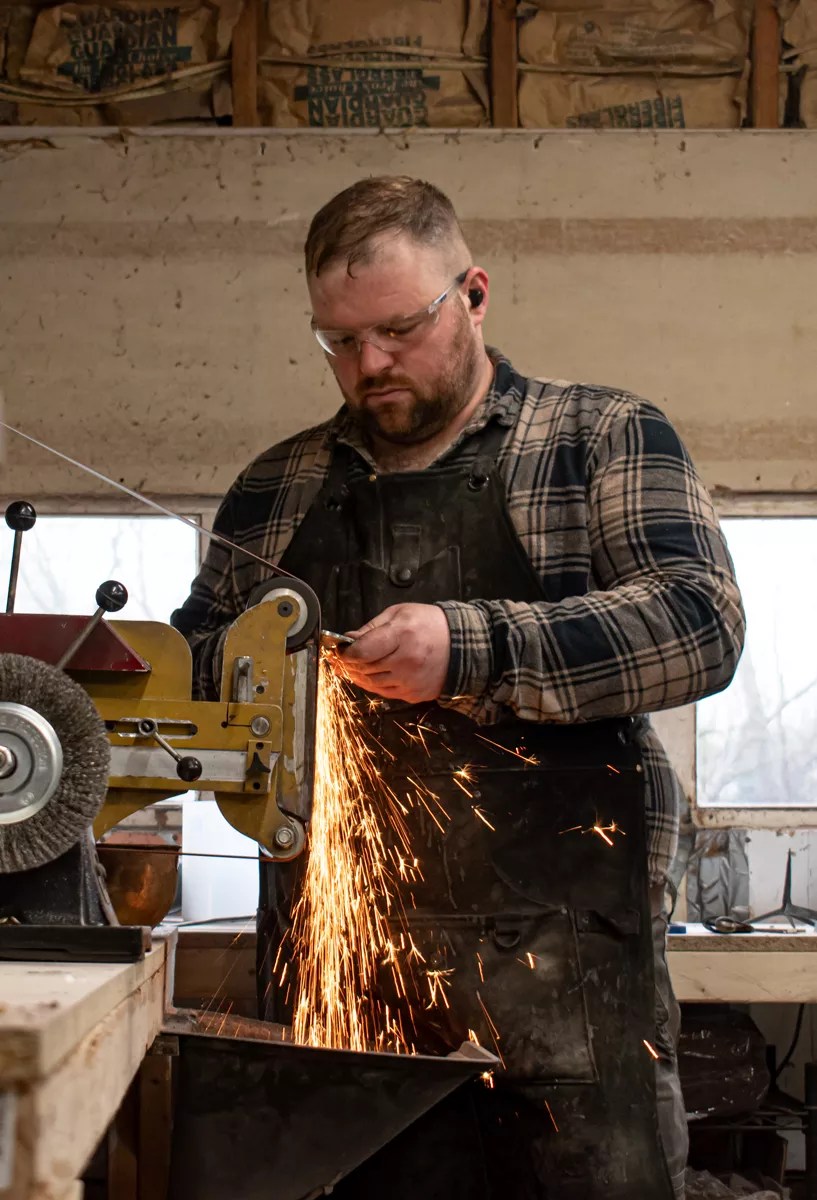
“We’re talking about material science, we’re talking about engineering, we’re talking about ‘how do you take steel and turn it into a blade?’” Spangler said. “Much of that can be done by machines now, but there’s something that it lacks. There’s a character.”
Of particular interest to Spangler is the trial-and-error methodology which built the science of metallurgy. In the post-industrial era, what makes steel harder, more durable or takes on other unique properties became better understood as something aside from magic.
But that wasn’t always the case; he pointed to a Norse technique as a specific example. Viking production of a sword, known as an Ulfbehrt, was marked by the excavating of tombs for bones (or sometimes, animal bones), which were then ground and used in the smelting process.
It was ritualistic undertaking with a practical result: to the Vikings, it was likely believed the process was imbuing the spirit of an ancestor into a blade, granting it their power, although little contemporary writings exist of the ritual itself.
T hose in the modern era know it was adding carbon to the blade, making it harder and stronger than the more commonly found bog iron weapons. Swords that had undergone the process were found to have about three times the carbon content of other iron weapons of the era.

“By mingling soft iron with ancestral and/or animal bones (where the animal bones might have indicated ancestry as well), the heated intercourse produced in the forge ultimately resulted in a birth of, for instance, a sword, which carried the strength and characteristics of the chosen parents; a new ‘person’ was literally forged,” wrote archaeologist Ing-Marie Back Danielsson in a 2008 report, “Bodies and Identities in the Scandinavian Late Iron Age.”
Spangler sees those stories as evidence of what “magic” is: things that work, without the requisite knowledge of why.
“He’s on the battlefield, and this sword, it’s going to chop spears in half, it’s going to shatter other swords, it’s going to do all of this great stuff,” Spangler said. “That’s pretty good evidence of ‘this is my grandfather’s spirit.’”
From his exurban backyard, Spangler is not digging up bones or performing arcane rituals in the literal sense. But an argument can be made for the spiritual sense.
Each hammer strike follows thousands of years of tradition, long before anyone knew the exact reason the steel could be molded. Those strikes are born proudly on the blades of Spangler’s knives — left raw and unfinished, in contrast to the blade edges polished to a mirror finish by a belt grinder.
He could polish them to a shine but chooses not to. For him, leaving the roughness lets the holder know the spirit put into the knife’s making.
“There’s just something cool about holding something in your hand that has weight, feels right,” Spangler said. “I think people have been craving authenticity for a long, long time.” spanglerforge.com
Gino Fanelli is a reporter for WXXI/CITY. He can be reached at gfanelli@wxxi.org.

This article appears in Dec 1-31, 2024.