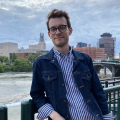
Every weekday by 7:30 a.m., William Smith arrives at Foodlink’s community kitchen on Mt. Read Blvd. for food prep. By 9 a.m., he sets up at the Foodlink Community Café located in the Central Library’s Bausch & Lomb building downtown. When the café opens at 10 a.m. for its lunch rush, Smith is ready to greet some familiar patrons.
“I do this for the passion. Ain’t even about the money,” Smith, a café crew member, said. “Just watching how much joy is on people’s faces that they know they could come here every day, and we’re reliable, and everything’s going to be great every time.”
Since Foodlink’s café opened in 2021, it has become a place for, as its name suggests, true community. That was built into the mission, according to Jes Scannell, Foodlink’s vice president and senior director of career empowerment initiatives who helped get the restaurant off the ground.
Subsidized “Mission Meals” are $3 — one sandwich or flatbread pizza with a side of soup, mac salad, fruit or salad and a water to drink. Guests can also pay it forward to help cover the cost of other diners.

“You can give us your change,” Scannell said. “We’ll have folks that come in get Mission Meals and then get a new job or something like that and drop a $20 when they get their first paycheck because we supported them through that time. They value the community we’re creating here.”
That includes the workers like Smith, who completed Foodlink’s Career Fellowship Program before getting hired at the café. He initially entered the program after, as he said, “a few bad life decisions.”
“I had to really ask myself, what can I do for the rest of my life that I actually enjoy doing?” Smith said. “That made all the sense in the world to me: cooking. I could see myself doing this all the way ‘til I’m 80.”

November finds the tenth class beginning its pre-apprentice training just as the preceding fellows move on to kitchen work. They’ll spend time learning knife cuts and food safety, among other skills.
In the second part of the program, the apprentices work at the café learning equally essential expertise: serving customers and taking orders at the register. Scannell said it’s become increasingly commonplace for traditional back-of-house restaurant employees to deal with customers directly; Foodlink adjusted its training accordingly.
Chauncy Anderson, the café’s supervisor and a former fellow, calls that socialization a highlight of the job.
“We take pride in learning about people, knowing what they like and just being friendly and having a conversation with people,” he said. “That’s what this café is for me. It’s about caring about people, showing love to people, feeding people and making friendships.”
Anderson is also the talent behind the Chauncy Chocolate Chip Cookie, a menu staple. Smith, meanwhile, recommends the Top Notch Tuna pressed sandwich, which pops with unexpected honey mustard and banana peppers.
Foodlink prepares around 10,000 meals per day at its community kitchen. The café likewise focuses on fresh ingredients made from scratch and not, as Scannell said, “opening cans.”
Between facilities, there are moving parts that need to be aligned. That, too, is a teaching opportunity.

“The fellows are learning the importance of really checking off the list and making sure you have tomatoes in the van, because by the time you get here, if you don’t have tomatoes, you don’t have tomatoes,” Scannell said. “A lot of folks have food-truck aspirations or want to be business owners. It doesn’t happen unless you suffer the pain of no tomatoes.”
KayJona Rogers was one of the fellows who helped open the café in 2021. Now, she runs her own catering and private-chef company, Taste of Kay, and cans her own proprietary Rasta Pasta Sauce at Paul Guglielmo’s Craft Cannery in Bergen.
“(Foodlink) gave us the opportunity to be a part of the menu planning, giving out different suggestions for the café,” she said. Eventually, her own jerk seasoning ended up in a few dishes. “It helped show people that I came from a program just like you, and maybe someone that you know might be interested. You could do it, too.”

One element is clear: Restaurant work is never easy. The first eight weeks of the program almost always find some fellows reconsidering their placement there.
“‘Do I want to chop onions all the time?’ It’s not sexy,” Scannell said.
But it’s a starting point.
At the end of those eight weeks, the program holds a moving-up ceremony where the fellows create their own dishes — “a bite that’s of their culinary perspective,” Scannell said — incorporating something they’ve learned so far.
“We shut the café down for traditional sales and ring around this room with people in their chef whites and their bites, and they get to explain what it is,” she said. “We welcome the whole community, their nominators and their family to come in and see. That’s how we introduce new fellows.”
It’s the kind of celebratory atmosphere Smith can see himself in long term.
“The vibe is always vibrant,” he said. “It’s always love, even on the down days.”
Patrick Hosken is an arts reporter for CITY. He can be reached at patrick@rochester-citynews.com.

Related Stories

This article appears in Oct 1-31, 2024.