


The exhibit of
David Levinthal’s photographic works at the George
Eastman Museum, “War, Myth, Desire,” follows the
museum’s 2014 showing of monumental photos from his “History” series. This
current exhibit is a retrospective, created with the intention of both highlighting
the recent major acquisition of Levinthal’s works by
the museum and also exploring the overarching themes present throughout his 40-year
career. Levinthal chose the title “War, Myth,
Desire”to also reflect some
defining and enduring themes of the human experience. While the exhibit showcases
his photographs of toys, the framing of the work calls into question what Levinthal has to say about his chosen themes.
Dozens of Levinthal’s
images from several of his major series are presented in the museum’s Main
Galleries without an artist’s statement and with minimal curatorial commentary.
This avoids giving viewers an overt directive and narrative while it allows
individual viewers’ reaction to the images to become the central part of the
exhibit, rather than the images themselves. Throughout the show, staged and
photographed army men, Barbie dolls, and other intricate figurines are used to
explore some of the basest parts of American history and popular culture,
presented from the perspective of the white male gaze. The audience is
challenged to decide: are the works critiquing or reiterating these themes? Are
they deconstructing or reinforcing stereotypes?
Icons scattered through the
exhibition space alert viewers to an accompanying podcast that can be accessed
online or over the phone, in which carefully selected questions are posed to a
bevy of experts in visual and social fields. Aside from this resource the
museum is also offering some upcoming related programs including two curator’s gallery
talks this summer and winter and an artist’s talk on November 1.

If the themes of war, myth, and
desire provide a construct for the exhibition, the presence of large Polaroids
and larger inkjet prints that are saturated with color dictate the show’s direction.
Though the first room is filled with Levinthal’s
earlier works, which are smaller in scale and more subtle in their color than
his later and most recent works, a large inkjet from his “History” series is positioned
as the first and most dominant image at the entrance of the space. This
introductory image, titled “The Searchers,” features a lone, masculine figurine
in blue jeans, a red shirt, and a dark cowboy hat, with a rifle held by the
barrel and slung across the shoulder of the toy.
A narrow depth of field is used to
give the illusion that the figure is staring off into a distant sunset. The
only other figure in the image is a skull; possibly that of a steer. This
masculine conqueror who looks out onto land which is or could become his is a recurring
character in Levinthal’s work. Not that he is
physically present in each image, but his brash and bold survey, exploration,
and ownership of all before him can be felt in each of the images throughout
the themes of war, myth, and desire.
The topics of desire and war feature
heavily in Levinthal’s earliest works, displayed in
the first room of the exhibition. The small scale, subtle colors, and
salon-style hanging of the works invite the viewer in for closer examination.
In the groupings of “Bad Barbie,” “Modern Romance,” and “Porno,” Levinthal
positions the viewer as voyeur, a peeping tom that must lean in to see what the
dolls are doing. Despite not having genitalia of their own, the figures positioned
to imply sexual activity or heightened sexual tension.
While many of Levinthal’s
photographic skills were developed during the Vietnam War, the war images that
are side-by-side are from his “Wild West” and his “Mein Kampf” series.Simulated battles are present
throughout the works, but the literal wars represented were not contemporary to
Levinthal. Instead, the war photographs look back
through nostalgic lenses, the heroes and bad guys clearly defined.

“Wild West” contains some of the few images of brown people
in the show, but they represent characters instead of people, and play into shallow
pop culture tropes of Native Americans. Armed and on horseback, the figures are
central to the photos, and Levinthal played with
focus and depth of field to create a sense of motion, rushing, and urgency. They
seem to gallop past the viewer, moving horizontally across the image as if into
the next photograph or across a television screen.
The cowboys in this series are
presented as heroic rescuers; taming a horse or riding directly toward the
viewer and into action that could be happening on the museum floor. In her
remarks during the exhibit’s opening, the museum’s Curator in Charge for the
Department of Photography Lisa Hostetler said that our national identity was
strongly shaped by the ubiquitous presence of the West in film and popular
culture during the 1950s and 1960s. She claims that because of the way Levinthal photographed the toys, viewers are given space to
consider the viewpoint of both the cowboy and the indigenous people of the West.
On the surface, the “Wild
West” images are not about the
atrocities committed upon Native Americans but celebrate the lone cowboy,
rushing from the image to rescue the viewer from the unseen surrounding hordes
of natives. The work explores the American myth of the heroic cowboy who is
credited for taming a people and a terrain. But where it could have built a
narrative that recognizes the accomplishments, sovereignty, and humanity of
indigenous peoples prior to the arrival of American colonizers, the series merges
war and mythology and relies on its audience to determine the difference
between nostalgia and criticism of an American West that never was, but that dominated
popular culture for a generation.
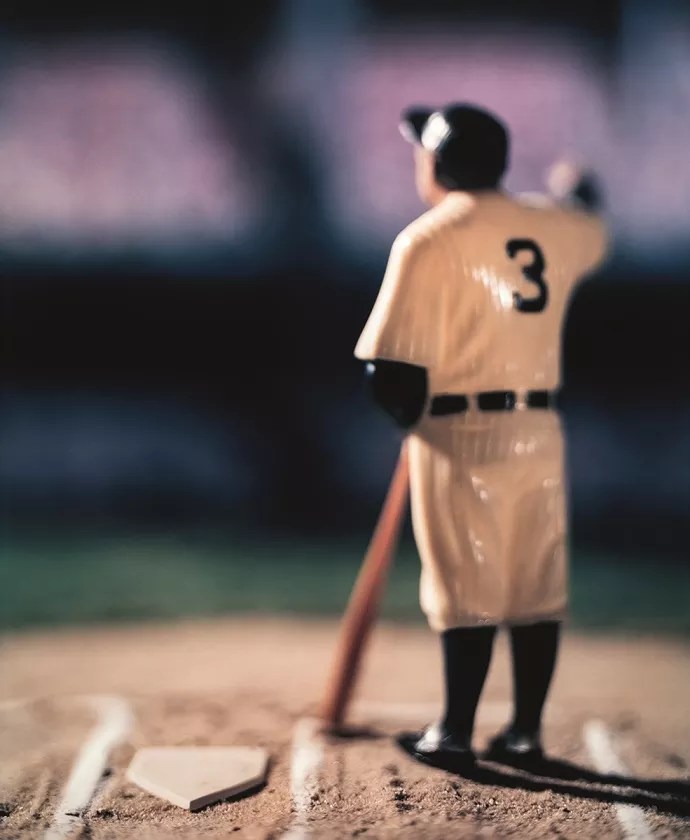
Circling the room counter-clockwise,
viewers next encounter images of sports and athleticism in a section
labeled “Baseball and Hockey.” Though
they echo the war images’ evocations of heroism and action, the sports
figurines are shown with less environment and background than the images that
directly reference war. Many are also lacking the depth of field technique used
to imply motion, action, chaos, and destruction shown in the war images.
Combined, these techniques make the sports
images feel similar to the ones in the next suite of images labeled “Desire,”
but they are different from the images of feminine figurines in how their
lighting and framing highlight the toys like heroic champions and instead of
anonymous objects of the male gaze.

Again viewers are left to decide if
the images are purely representations of nostalgia, or if they reflect a
culture that holds battle and toxic masculinity in such high regard that
athletes become the subject of a twisted hero-worship.
Interestingly, the sports section
has one of the only toys representing a person of color without the negative
tropes, stereotypes, and one-sided nostalgia associated with the other brown
and black people featured through the exhibit: A single central figure, lit
dramatically, and framed and treated similarly to the other sports figures. But
it’s the only sports figurine without the hazy background environment implying
a stadium, audience, and outside action.
The figures, tchotchkes, and racist
memorabilia in Levinthal’s “Blackface” series are also presented without hint of
environment — they’re posed in front of a dark background, and lit in a way
that highlights their colors and exaggerated expressions.Curatorial information states that
the series is intended to highlight the insidious and pervasive nature of the toys,
advertising, and household goods that depicted caricatures of black people. But
their placement, between Levinthal’s “Passion” and
“Space” series, has them flanked by themes of sexuality and mythology. It was jarring
to see this propaganda — a tool of warfare used against black bodies in America
for centuries — positioned with the mythos of the hypersexualized white woman
and of the Space Race instead of the images of war. These objects are not a
source of warm nostalgia for many viewers.
There are few legible words within
any image in the exhibit, and for the most part those that are clearly legible
serve to create atmosphere or give the images a sense of place and environment.
A notable exception is the first blackface image seen straight-on when turning
right and walking into the second gallery space. The word “mammy,” a word used
for generations to diminish black women, is visible on a lidded jar shaped like
a plump figure.

During his exhibition preview talk, Levinthal discussed how the “Blackface” Polaroids aim to
monumentalize the objects and confront the audience with the nature of their intended
purpose. But it’s unclear how the images and their placement in the exhibition
contribute to the conversation of race and identity in America in a
constructive way, or if they sustain the new popular narrative that the
destructive representation of people of color in popular culture is a thing of
the past, like the Space Race. Are racist depictions of black people a
titillating and tantalizing experience, like the “Desire” images?
And during an interview with Levinthal after the exhibit walk-through, he admitted his
work is informed only by his own limited experience and lens, which has clearly
influenced his understanding of the role of popular culture on the American
psyche. He says many of the images he created
because of his fascination and curiosity around the figurines he collected — in
his career he’s examined multitudes of objects created for a white audience.
While he recognizes that everyone brings their own personal and cultural history
when viewing a work of art, Levinthal hopes that the
work both entices and confronts audiences. Both Levinthal
and Hostetler expressed a hope that the viewers reflect on and discuss not just
the emotions that the exhibit may evoke, but the source of those emotions.
Levinthal
does not moralize in his work, and the exhibit’s presentation allows viewers to
come to their own conclusions about what ideas are being presented. But without
the guidance of the podcast or the curators
walkthrough, the audience might struggle to reach the conclusions intended by
the museum and the artist.
This article appears in Jun 13-19, 2018.





