


The Memorial Art Gallery last fall reimagined one of its
smaller exhibition spaces as a Media Arts Watch Gallery, dedicated to film and
media arts, and curated
by John Hanhardt. The series will continue for two years, but through March
26, collaborative artists Gibson +
Recoder (Sandra Gibson and Luis Recoder) have taken over the space with
“Light Spill,” a minimalist installation that has been collected by the MAG.
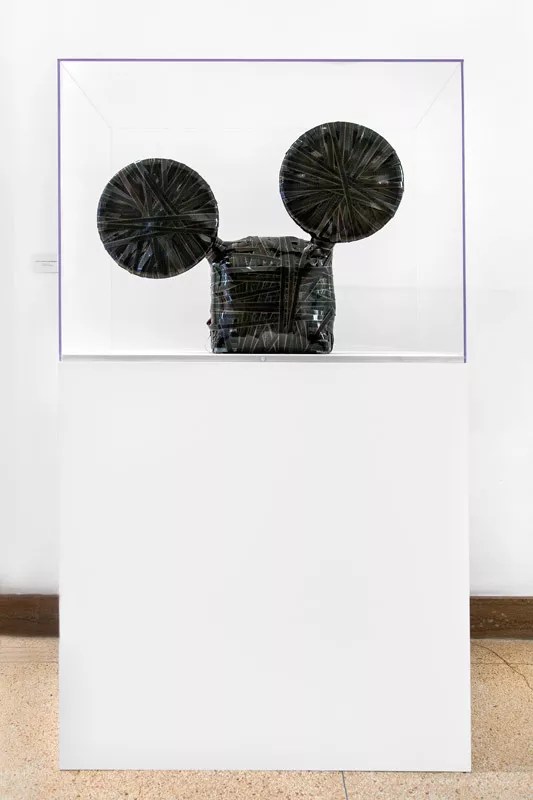
Just outside of the space, a case holds “Threadbare,” a 16mm
projector that Gibson + Recoder have wrapped in film. The mummified effect
creates “a still life of motion picture phenomena,” they say. What would
normally run through the machine encases it, creating a flipped, inside out
encounter, and arresting its potential for motion, and creating a sculptural
object. Its reels also look a whole lot like Mickey Mouse’s ears.
Provided information states that the Brooklyn-based artists
consider film as a particular material experience rather than an event that
unfolds over time, and that they expand the concept of film beyond images and
storytelling to examine optical, mechanical, and sculptural dimensions. To
achieve this, their work dismantles and recombines the components of film
screening systems.
Inside the gallery, “Light Spill” consists of a 16mm
projector on a pedestal aimed at a projection screen. The projector has been
altered by removing the collection reel, so that the film spills from the
projector and pools on the floor behind the base. The installation is rigged to
a timer so that every 30 minutes it will run for about a minute. Between these
moments of activity, the space is dark and filled with stillness. Anticipation
is a built-in aspect of the work.
“We see it as a kind of performance piece,” Recoder says.
“The projector has to be threaded by an attendant, so it’s really about the
activity of threading the projector.”
An attendant threads a new reel about once a day. During the
exhibition’s three-month run, the projector will go through 100 reels of film,
so viewers can expect a towering pile of unspooled film by the end. “Threadbare”
came after the concept of “Light Spill,” when Gibson + Recoder wanted to do
something with the spilled film.
The intermittency function of the projector — which typically
screens the film at 24 frames per second — has also been disengaged, Gibson
says, “so the film is running through the projector
without any stopping.” As a result, what is projected onto the screen is not a
discernable film, only blurred, colorful light fields.

“For us it’s not about the film content,” Recoder says. “The
film is material for us. We decided that the projection apparatus itself is
more intriguing. These are materials that are not meant to be shown, a
projector’s meant to be in the booth. Everything we experience as viewers is
all about the screened event, our experience in the theater.”
But as this older technology experiences rolling
obsolescence, we’ve moved even further from experiencing the performance of
these machines. There are probably younger people who won’t even know what the
material is, the artists say.
Gibson explains that their work consists of tableaus from the
projection booth that they present as performances. “Basically it’s a
performative instruction piece,” she says.
This article appears in The Smallest Minority.





