


Nearly half a century has passed since Paul Garland’s first
professional solo exhibition of paintings, which was held in February 1967 at
Rochester’s since-closed Janus Gallery. In celebration of Garland’s five
decades of intensive studio work and numerous solo shows in New York City,
Toronto, Chicago, Buffalo, Minneapolis, and elsewhere, AXOM Gallery is
currently presenting “Approaching Fifty,” a solo show of Garland’s pleasing work.
“Approaching Fifty” is Garland’s
third solo exhibition at AXOM Gallery since the space opened in 2012. In fact,
Garland’s “Convergence” was the space’s inaugural show, which presented three
separate painting series: non-objective abstraction, naturalistic landscapes,
and abstraction juxtaposed with landscape.
“Rather than solely concentrating on a single painting
objective, the direction of my studio practice for the past decade has been
deliberately directed toward three simultaneous unique painting series,”
Garland says in a provided statement. “Rather than one single direction my
focus is multifaceted.”
Last summer, Garland exhibited a series of 16 naturalistic
landscapes based on the beauty of Fair Haven, New York, where he currently
lives and works.
Artist and AXOM curator Rick Muto has known Garland since
college, and they are both West Irondequoit natives. “Paul has always been a
non-objective painter,” Muto says. “The underlying aspect of his different
series is that there’s always a spontaneous reply to a piece of art that he
never really set out with a solid idea to do anyway. I guess I would call it a
stream of consciousness.”
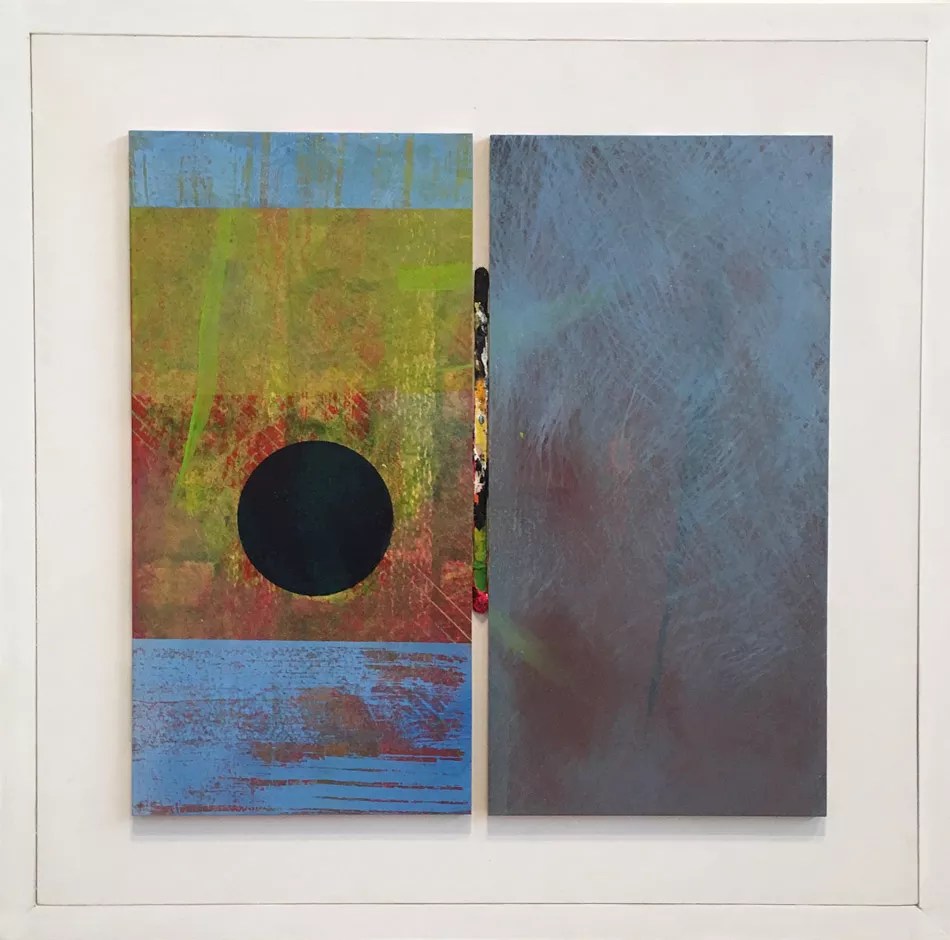
This particular show includes two different series of new
work. Garland says the first series, “NOW,” consists of modernist abstractions that
“symbolize one’s inevitable life experiences of facing abrupt change and
confronting how to effectively deal with loss.”
Garland’s approach in constructing this work was to develop a
piece of art, and in mid-stream, “when it’s at a point of a reasonable level of
success, he puts in on the table saw and cuts it,” Muto says. “He then tries to
mend or resolve the problem he’s created, which will throw him into a whole
different avenue.”
Garland writes in his statement that while slicing the work “may
seem to be a monumentally stupid act the resulting two parts present new
painting opportunities and/or dilemmas. Flipping, inverting, upending the past
and searching for renewal.”
The fragmented pieces are usually applied or layered on top
of other works to create an assemblage. In many of the pieces, Garland also
incorporated one of his old paint sticks he has used and kept in his studio
over the years. “The sticks, replete with a mapping history of their own, serve
as a bridge between the bifurcated halves of the original work and a physical/visual
connection to the past,” he writes.
These thin, pigment-encrusted sticks are often wedged between
the cut panels, breaking up the dark spaces between already vibrantly-hued
panels.

Garland is a colorist. His surfaces are ripe with unexpected
combinations of seductive hues, often contrasted with creamy neutrals or pitchy
shadows. And in each work, Garland strikes a careful balance between void and
harmony, positioning “the geometric against the nebulous,” as Muto puts it.
In that respect, Muto says he sees something of painter Wassily Kandinsky’s style in Garland’s work. “You can fall
right into the picture plane,” he says.
Though Garland works with acrylic, some of the pieces employ
layered glazes that read like luminous works of oil, and in one piece in
particular, “Much Of,” milky washes of paint over darker layers precisely
resemble the waxiness of encaustic.
Around the turn of the century, Garland began working with
the landscape imagery, creating what he called “Juncture Paintings,” in which
he’d pair a minimal, almost tonalist landscape with
an abstract painting. Some examples of this work are currently presented in a
narrow back hallway at AXOM.
At first glance the components might seem jarringly
juxtaposed, but the eye quickly picks up clever commonalities
in color, texture, or form between the different sides.
“There’s an element of happenstance at play,” Muto says. “He
wants to see the kind of tension created between the two sides.”
The second component of “Approaching Fifty” is “Square Moon Rising,”
a series of three large acrylic paintings on canvas that combine abstraction
with elements of landscape. In each, elegantly wraith-like floral elements
drift in and out of focus amid sweeping, deep color fields. The effect is like
a dream half remembered, where structures and imagery and atmosphere blend and
float, all of it permeated by a comforting darkness.
This article appears in Jan 11-17, 2017.





