“The
bar onstage is open. Enjoy!” With those words as a greeting, I entered the
Auditorium Theatre for Tuesday night’s performance of the Tony Award-winning
musical, “Once.” That cheery welcome prefaced a scene I’m not generally
accustomed to seeing at that venue: the stage, dressed to look like a charming,
somewhat dingy pub, was crowded with people. Bartenders manned the long, curved
(and apparently fully stocked) bar that ran along the back of the set. Audience
members were encouraged to walk up on stage and place their drink orders. This
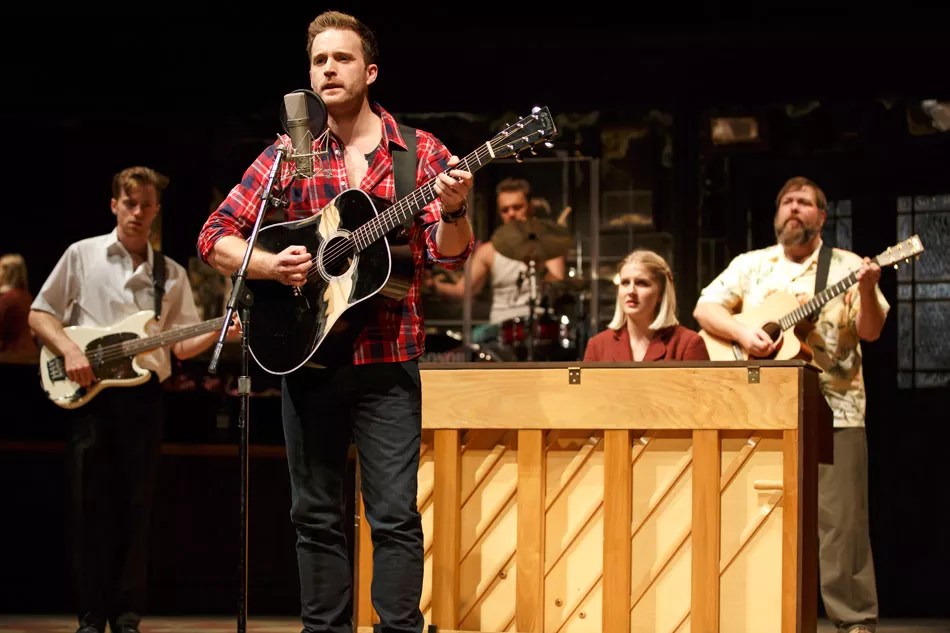
was, not surprisingly, a popular option. Musicians — actually the show’s cast —
mingled amongst the crowd, playing fiddles, dancing, generally carrying on, and
their raucous energy was infectious. As people walked freely up onto the stage
and back down again, the wall that typically divides the audience from the
stage was made permeable, so there seemed to be no separation between what
existed on stage and what was off. After some time, the line to the bar was cut
off and the stage eventually cleared of everyone except the members of the
cast. They continued singing, the house lights slowly dimmed, and only
gradually did it become apparent that the show proper had begun.
Part
of what made the film version of “Once” so unique was the way it took a genre
(the movie musical) not often associated with subtlety or naturalism and
crafted something deceptively simple and unassumingly delicate. I was curious
how a live version would be able to replicate that sense of intimacy when
translating the same story to the Broadway stage, and I have to say, those
opening moments put me immediately at ease. I can’t say for sure how well this
works for the entire theater, however. What seems “intimate” from the floor may
translate to “microscopic” for the back of the house. But I hope “Once” plays
just as well from any seat in the house.
Set in
Dublin, “Once” tells the story of a Guy and a Girl (just as in the film, these
are the only names given to the two lead characters). He’s a street musician
who makes a living working in his father’s vacuum-repair shop. She hears him sing and falls in love with his music. It
so happens that she’s employed at a music store with a
kindly owner who lets her play the instruments whenever she wants, and she
takes him there. She plays piano as he teaches
her one of his songs (the Oscar-winning “Falling Slowly”), which begins,
“I don’t know you, but I want you.” It’s suddenly clear how true those words
are.
He’s
still bitter and broken-hearted over a former girlfriend
who left him and moved to New York. She offers to join him in recording a demo
that could land him a record deal, and give him a chance to travel to America
to pursue the girl who inspired his songs. The Guy and the Girl recruit some
fellow musicians and begin to record, even as the songs they play become an
expression of the feelings that neither will fully acknowledge. He’s slightly
more willing, but she has obligations of her own, and remains adamant that no
“hanky-panky” occurs. The music they create forms the connection that draws
them closer together.
In the
touring production at the Auditorium, Stuart Ward and Dani
de Waal step into the roles originated in the film by Glen Hansard and Markéta Irglová. The parts are altered slightly for the stage:
he’s made into a more traditional leading man, younger and less scruffy, while
she’s a little goofier. The actors have a nice, natural chemistry, and their
voices are well-suited to the musical’s understated score. There’s not much
belting to be found here, but the emotions are big enough come through on their own.
Having
read little about the stage show beforehand, I was pleasantly surprised to see
that the location hadn’t been changed to some blue-collar city in America. The pub set feels right, with circular walls covered in grimy-looking mirrors. The cast nearly always
remains onstage, sitting along the edges and always ready to jump up to dance
or provide accompaniment (impressively, everyone in the cast is required to
play their own instruments).
For
the most part, the staging is kept as simple as the story. The only added
effects are projected subtitles, which allow characters to speak in English while the foreign words they’re
actually speaking are shown above them. Though it at first seems a tad
extraneous, they prove necessary for one crucial line delivery (though it’s
worth noting that when this line was said in the film, no translation was
provided). The musical’s book adds bits of broad humor that don’t
entirely fit in with the melancholy chords the rest of the show strikes. The
comedy comes mostly from the side characters: the Girl’s roommates and the
owner of the music shop, appealingly played by
Rochester native Evan Harrington (he even manages a convincing Irish accent).
The Americanized humor feels like one of the show’s few concessions to what
audiences believe a Broadway show is “supposed” to be. But for the most part,
the show remains true to the gentle, wistful spirit of the film that inspired
it.
This article appears in Mar 19-25, 2014.