


Luna Galassini gets paid to
eavesdrop on the private conversations of strangers. For nearly five years, she’s
worked as an independent contractor providing transcription services for clients, including prosecuting
attorneys in Los Angeles. Galassini, who lives in Rochester, receives recordings — primarily
interrogations and jail phone calls — transcribes them, and sends her
transcriptions back.
Galassini is digitally collaging excerpts of these dialogues
with found imagery to create a sort of psychogeography
mapping project. Her project, “Monitored or Recorded,” currently set up in Visual Studies Workshop’s Project Space, seeks to form
impressionistic connections between personal experience, the visual vernacular
of the digital world, and the stories on which she eavesdrops on a daily basis.

Galassini says she learns a lot
about people’s struggles through the conversations, each of which can result in
transcriptions of more than 100 pages. “I’ve barely ever had a phone call that
was about a crime, it’s usually just people talking about their lives, so
that’s a really weird thing to eavesdrop on,” she says.
“Even at this level of distance, it’s incredibly difficult at
times,” she says. “Whether they’re talking to detectives, or talking to their
wives, you learn so much about someone’s life and history. So many of the
interrogations start with the family history, like, ‘Where are your parents?’
and they’re dead or in jail. ‘Where are your siblings?’ and they’re dead or in
jail. It’s really easy to see how these things are systemic. At a certain
point, it got to me, and I wanted to figure out a way to give some voice to
that.”
Galassini begins with taking bits
of conversation out of context — from intimate dialogues between family members,
and from more combative interrogations — then digitally fuses those words or
phrases with images that include Google Maps screen captures or stills from L.A.
rebellion films that focus on race.
The associations between text and imagery are built
organically and loosely. Having never been to L.A., Galassini
has to Google things she’s unfamiliar with, such as street names or local
vernacular used by gangs, usually to check for correct spelling. She’ll eventually
find the information she’s searching for, but these trips down unexpected online
rabbit holes serve as launching points into random and unexpected territory. “All
kinds of things will come up,” she says.

Other screen captures result from looking at the different
prisons that she’s become familiar with through transcribing, and “walking
around” Google Street View. “Pelican Bay is a prison that’s way upstate in
California where everyone wants to go, because it’s like the ‘nice’ prison,” she
says. “It’s basically surrounded on all sides by forests, and the ocean is 10 miles away.” In looking at Galassini’s Google
captures of the vicinity, a certain tension between that wide open wilderness
and the jail-cell dialogues emerges.
“I want the images to be interesting, but they’re also kind of
noise. The text is the point,” Galassini says. The
images will be “weirdly beautiful things coupled with this sad text. You can’t
really ignore it. In all of the collages I’ve done so far, the text is more
emotional, it gets to you,” she says.
Galassini decided to incorporate
the text in ways that would allude to the aesthetic of the digital world. It’s sometimes
presented like subtitles on a movie still, in other cases, within social media
message bubbles or in the drop-down menu of Google’s search bar suggestions. “I’m
trying to get them to a place that’s a little bit impressionistic, but still
gets across the idea of the browser, or the user interface that most of us are
familiar with,” she says.
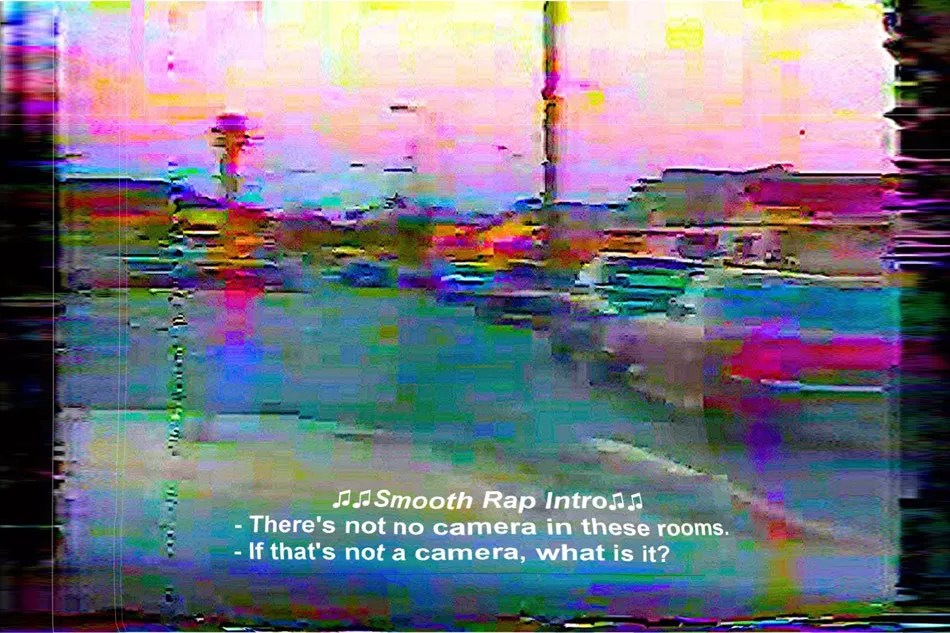
“The point of this project is to get across this very weird
but also intimate and alienating experience that I have with these transcripts,”
Galassini says. While working on a transcript and
doing fact-checking research, she is virtually immersed in the experiences and
environments of strangers. But she’ll also take a break to check Facebook and
her own world.
“Something I keep thinking about is: a couple of weeks ago
when Lemmy died, that was the same night there was no
indictment in the Tamir Rice case,” she says. “I was
texting with a friend about how ‘black internet’ was talking about Tamir Rice and ‘white internet’ is just talking about Lemmy. And that’s sort of where the idea to make this a
digital project rather than a photography project — rather than going to L.A.
to take pictures — came from. It’s this idea that what I deal with when I
listen to this recordings and I transcribe them, even if there are
distractions, it’s not something that I can block out.”
“Monitored or Recorded” doesn’t seek
to present a narrative from one specific transcript. “For me, this is about a
broad, larger narrative,” Galassini says. “There are
specific stories that I think are really heartbreaking for specific reasons,
but the project is not about those stories. It’s about navigating L.A. from a
distance, navigating a lifestyle from a distance.”
It’s also about the political issues of civil rights,
poverty, race, and class, she says. “I think it would be hard for anyone to
listen to the number of teenagers that I’ve listened to who are facing life
sentences — no matter what they’ve done. That’s really difficult. The systemic
nature of the problems become immediately clear when you hear not just family
histories, but what jobs people work, how many kids they have, the daily struggles
people go through. I tend to be pretty pragmatic, and I think I can be
relatively empathetic for both sides, but the way that cops treat these kids
when they come in is impossible to ignore. And I’ve transcribed things where
40- or 50-something guys immediately drop their pants, and the other voice says, ‘Oh, you don’t need to do that,’ but they’ve been strip-searched so many times,
they just want to get it over with. They don’t even care anymore.”
Galassini says she doesn’t feel
comfortable being overtly political about the project, but that she is trying
to evoke an emotional response with the work. “I think the voices in the text
speak for themselves better than I could by imposing a message on it,” she
says.

The project is “really far reaching and hard to distill, but
what I’m trying to do is get across this really sad stuff that I deal with and
that a lot of people deal with in a more distanced way by reading or watching the
news,” she says. “I just happen to have a direct line into it through the
transcripts.”
Galassini’s goal is to have eight
final images ready for her Friday night reception, which will be presented on
wall-anchored, custom-made light boxes. Illuminated from behind, the super
saturated digital collages, viewed in a darkened room, will simulate our
familiar experience with the glowing screen.
See the work: First
Friday, February 5, 6 to 9 p.m. at Visual Studies Workshop (31 Prince Street). Galassini will keep working on “Monitored or Recorded” in
the VSW Project Space through February 19. An artist talk will be held
Wednesday, February 10, at 6 p.m. For more information, visit vsw.org.
This article appears in Feb 3-9, 2016.





