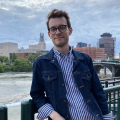
Age: 61
Hometown: Binghamton
Current residence: Penfield
Occupation: Digital content creator
During a recent MRI, John Kucko laid inside a tube with a cylinder resting inches above his face. Physically, he remained still for about 30 minutes while the machine captured images of his brain.
But mentally, he took a trip to the Adirondacks.
“I just closed my eyes and started thinking about Lake Placid,” Kucko said. “It was really snowing good, which I love.”
It’s a trick he’s used before to deal with stress, sometimes substituting the “spellbinding views” of Watkins Glen’s gorge in autumn. It only makes sense that Kucko’s mind brims with the same beautiful vistas he shares regularly on his Facebook page, John Kucko Digital, to an audience around the world.
Rochesterians know him from his 32 years as a local broadcaster, covering sports — including 19 Super Bowls — and eventually anchoring alongside his daughter Natalie on WROC-TV.
When he stepped away in 2023, Kucko’s focus turned to his digital page, where scenic videos of waterfalls around New York State mingle with bits of local history and bright springtime blooms. It’s all captured with a reporter’s curious eye and knack for colorful details.
“My big stress in life prior to this was what waterfall am I going to go to? What babbling brook am I going to listen to this day?” Kucko said.
The stressors are different now. He’s lately endured a lot of medical imaging and care.
On May 26, while visiting Letchworth State Park, Kucko photographed a majestic and vibrant rainbow cresting Upper Falls. Shortly after, as he drove back toward Rochester on Interstate 390, he suffered a seizure and a brain hemorrhage, causing him to crash his Ford Bronco. He luckily survived, but doctors soon discovered a brain tumor and operated to remove it.
Some cancer remained in the surrounding area. Thus a long road unspooled ahead — six weeks of radiation and chemotherapy, which he began in July.
Yet somehow, just four days after the accident, Kucko attended the wedding of his daughter Caroline. That kind of unyielding resolve has set the tone for Kucko’s journey.
It’s in every update he offers on his Facebook page, even the ones where he confesses being exhausted and having to scale back his early morning walks. (In mid-July, he was still getting in two or three miles a day — more than many folks without brain cancer.)
“I’m going to push it hard. I’m going to work very hard to get better, and then I’ll be hopefully back to doing what I normally do,” he said, crediting the support of his wife, Charla. “You’ve got to have your limitations. It’s something I’m not real good at. But I’m learning quickly.”
Before his diagnosis, Kucko would spend a day bounding from Watkins Glen to Ithaca and back to Penfield, capturing covered bridges, railroad arches and restored barns. He began posting “60 Seconds of Serenity,” perhaps his signature nature video series, during COVID; he’s since shared more than 2,500 peaceful clips.
Now, though, laying on his stomach to shoot the water in Pultneyville wipes him out; though it won’t stop him from posting the dozens of beautiful landscapes, hydrangeas and lighthouse scenes he’s captured over the years.
His audience has come to expect those, after all. But they’re also along for his latest journey, in which Kucko chronicles himself and his health.
“This will be different,” Kucko wrote on his Facebook page in early July. “I will be bringing you with me on this odyssey, an unforeseen set of circumstances that have put me and my family into this moment.”
One of those circumstances was the highly unusual, science fiction-sounding surgery itself. Doctors opened Kucko’s skull and brought him out of anesthesia in the middle of the procedure in order to test his speech.
“I was a little groggy, yes, because part of the head was open,” Kucko said. “But I was cogent enough to talk with the surgeon, and he could pinpoint exactly what he could take out and what he couldn’t touch.”
This kind of borderline-miraculous medical intervention requires a dedicated team. One researcher Kucko shouted out by name is Dr. Frank Garcea, the director of the Language and Skilled Action Laboratory at the University of Rochester Medical Center.
Garcea’s work maps the brain and focuses on its ability to pick up and use objects and retrieve memory, as well as speak about a person’s own experiences and understand others’ speech.
Part of this research requires talking to patients in the middle of their brain surgeries.
“There’s a delicate dance between the neurosurgery team and the anesthesia team,” Garcea said, likening the procedure to a symphony. “But what you can observe in real time are changes in a person’s ability to speak.”
There’s a concern Kucko may lose his speech altogether down the line. But doctors initially worried he’d lose it for a few weeks after the surgery — and that didn’t happen. Kucko was talking just after he woke up.
There’s that resolve again. It seems to be embedded in everything he does.
“Statistics suggest I have a year to two — some get lucky, most don’t,” Kucko wrote as he began treatment. “To this unexpected illness I say: ‘you don’t know me, and you’re about to get a load of aggressiveness from me that I’m going to hammer you hard with.’ This may be unpleasant — but I will give it everything I have.” facebook.com/JohnKuckoDigital —PATRICK HOSKEN