


Yggdrasil has played at the LutheranChurch several times at past XRIJFs, but I’ve never taken in a set until Saturday night.
I was afraid they might be a little too new-agey for
my taste. Instead, I was blown away by not only the talent of all seven members
of the group, but also by their deep-rooted Scandinavian repertoire.
Eivor, who was with them this
year, is simply an incredible singer. At times she sounded like the lead singer
of the great Irish group, Clannad. And, when Yggdrasil performed a magnificent Shakespeare sonnet set to
music, she seemed to be channeling Kate Bush. These are compliments, but the
best compliment is: most of the time she sounded like Eivor.
It didn’t hurt that she looked like a storybook character, a good witch with
long blond hair, accented by a long black dress with the texture of seal skin.
(I don’t really think they’d go that far for authenticity.)
The group, made up mostly of names I can’t pronounce, was fantastic, from
the fiddler to the flautist to the pianist and the rhythm section. Each had an
unorthodox approach to his or her instrument and the combined sound was simply
otherworldly. The good news is, you can catch Eivor and MikaelBlak tomorrow night at 7:30
p.m. and 9:30 p.m. And Yggdrasil’s leader KristianBlak goes solo at Hatch Hall at 5:45 p.m. and 7:45 p.m.
on Sunday.
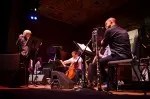
Earlier in the evening I caught Tom Harrell‘s Debussy &
Ravel Project at Kilbourn Hall. Both Impressionist composers are favorites
among jazz musicians due to their experimentation with unconventional
harmonies, melodies, rhythms, and voicings. So when
Harrell and his superb band played an hour and 20 minute set of (and in the
spirit of) their music, it just seemed like cerebral jazz.
Harrell, who suffers from schizophrenia, never made eye contact with the
audience. He walked slowly with his head down, every movement deliberate. But
when he picked up his trumpet or flugelhorn he came to life. And he got better
as the set progressed, with the last three tunes (two of them by Harrell, one
by Ravel) the best.
His ensemble, enhanced by violin and cello, boasted some top players.
Especially strong on solos were WayneEscoffery on tenor sax and Charles Pillow on various
woodwinds.
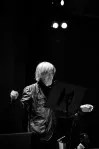
I also caught pianist Bill Cunliffe,
who played a far more traditional show at Hatch Hall, the Eastman School’s
beautiful, new, and intimate (read: small) venue. Cunliffe
took advantage of the intimacy and had an ongoing chat with the audience
between tunes.
He reminisced about his days as a student at Eastman three decades ago, and
even did a pretty good Rochester
accent. And he talked about the first album he made after moving to Los
Angeles, a CD of Paul Simon songs.
He said he was skeptical at first, but then he listened. The story was followed
by a four-song Simon medley that included a beautiful rendition of “Bridge Over Troubled Water.” But the high
point of Cunliffe’s set was
when he got deeply into a truly great composition, Thelonious
Monk’s “Round Midnight.”
Sunday night I’ll be in Kilbourn Hall checking out some great musicians in
their new project, Ninety Miles, inspired by the music of Cuba.
Then I’ll head over to ChristChurch
for the progressive British group Breach. And, finally, I want to hear what
Jacob Fred Jazz Odyssey has been up to lately at Xerox Auditorium.
Looking for more of City’s Jazz Fest coverage? Click
here for City’s 2012 Jazz Fest Guide, click here for
our Jazz Blog landing page, or Like City on Facebook or
follow us on Twitter @roccitynews
This article appears in Bye bye unions?.





