


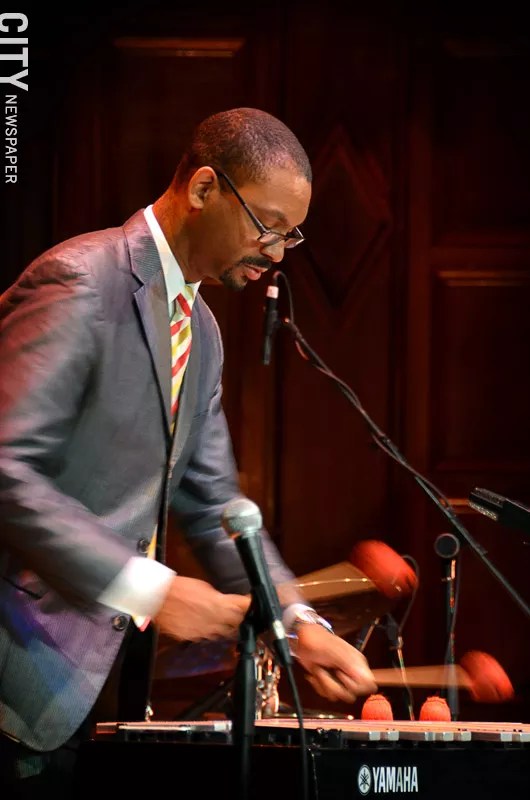
At Kilbourn
Hall on Saturday night, the Jason Marsalis Vibes Quartet provided
a stark counterpoint to many XRIJF bands. Instead of the loose-fitting clothes
favored by physically active musicians, all four of them wore suits and ties.
This buttoned-down look would seem to contradict the freedom inherent in jazz,
but even that freedom was under control. There were no 20-minute rambling tunes
here; each composition lasted about five minutes. Marsalis kept glancing at his
watch (at least eight times). A one-hour set was going to last one hour.
If all of the above
sounds negative, it’s not. I just found it to be a fascinatingly different
approach from a unique jazz personality. In fact, Marsalis and his band were
great. It was refreshing to have each tune be a distinctive entity rather than
a meandering jam. There were beautiful ballads (“Nights In
Brooklyn”) and sneaky sounding melodies (“B.P. Shakedown”) and even a tone poem
of sorts about a man who could not dance.
Solos were short, but
excellent, with an occasional quote from a Monk tune or another classic. These
well-groomed men let loose in their music in a manner reminiscent of a
dressed-up 1950’s band. Marsalis’ polite demeanor did not prevent him from some
astute political remarks that drew applause from the crowd. The show ended at
exactly 7:02 with a standing ovation but no encore.
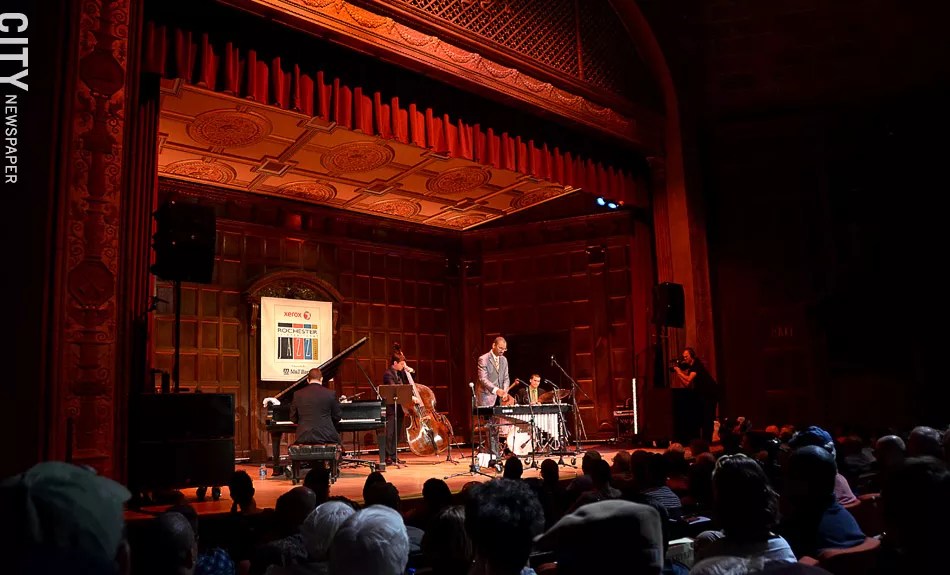
Over at the Lutheran
Church, the Sunna Gunnlaugs Trio proved
to be a little too milquetoast for my taste. Gunnlaugs
is a fine pianist, but her set seem pre-programmed, with the band taking few,
if any, risks. Still, she is a beautifully melodic player with a style that
worked well on the group’s cover of Tom Waits’ “Johnsburg,
Illinois.” Gunnlaugs saved the best for last, with
the entire group coming alive on a song titled “Gallop.”
The John Escreet/Tyshawn Sorey Duo,
over at Christ Church, made me suddenly desirous of a little milquetoast. I’m
not sure if they were relentlessly experimental from start to finish, but they
certainly were from the start until I was finished with them 25 minutes later.
Escreet
banged at the piano while Sorey banged at the drums.
Sometimes Escreet’s hands went inside the piano to
make meaningless noises there. Sometimes Sorey threw
drumsticks in the direction of the audience. At no time while I was there did
they approach playing anything I would call music.
Sunday night, I
can’t wait to see Cécile McLorinSalvant, one of the
most heralded new singers on the jazz scene today, at Kilbourn
Hall. Then I’ll catch the young pianist Gerald
Clayton at Hatch Hall and bassist Euan Burton’s group at Christ Church.


This article appears in Jun 25 – Jul 1, 2014.






The sound in the church is typically challenging. On top of that, they didn’t get the dynamics right in the sound check. When they both played loud, you couldn’t hear Escreet at all. They were both miked. I thought about saying something to the sound guy but didn’t. I didn’t like the set much either, but I wondered if it would have been better with better sound dynamics. I have liked Escreet in the past.
The previous night for Partisans, I could hear the sax and drums clearly, but with the amps at the back of the stage all I could hear from the guitar and bass was a rumble. I know they play more cleanly than I heard. I wish the festival would either work on the sound in this venue or ditch it. It’s disappointing to go to hear good musicians and not be able to hear them.
It’s fairly telling that you begin this article talking about Marsalis’s bands’ clothes – it sets up the impression that you don’t particularly know how to write about music, a hypothesis you corroborate when you “reviewed” Escreet/Sorey.
I put “review” in quotes because what you did was actually no such thing. It was a dismissal and not even an in-depth one at that. Here’s a tip, man: if you’re going to review a jazz festival, get ready for some free improvisation and when it happens, know how to write about it.
I’ve seen enough reviews of these kinds of musics to know when a writer reacts on reactionary impulses rather than their ears. Your tell was when you called it “not music”, which is wrong as it is boring at this point.
Hi Dan,
Thanks for leaving a comment about this review and joining the conversation. Ron is a seasoned jazz reviewer and has covered XRIJF for City from the beginning.
But if you disagree with his review, please feel free to elaborate. We love hearing what our readers think, especially when they have another point of view. What are your thoughts on the Escreet/Sorey show?
And please, remember to be civil.
Hi Jake,
I didn’t attend the concert – I do not live in the Rochester area (I found this review from Tyshawn Sorey’s Facebook page, where he is taking it in jovial stride). I know that, on the surface, this may seem like it disqualifies from making a comment, but allow me to elaborate.
I am fairly acquainted with both Mr. Sorey’s and Mr. Escreet’s music. The two of them have a sonic rapport through their respective working groups, of which each musician is a member of the other’s ensemble. Though I have never heard these two play duo together, I *have* heard Sorey play duo with pianists before, most notably with Matt Mitchell – piano/drums is a format that Sorey happens to favor.
Being familiar with how these gentleman play music, it is statistically impossible for them to have, in Mr. Netsky’s words, not “approach playing anything [he] would call music”. It would be like going to a Chuck Close exhibition and saying there was nothing you would call a painting. These two are excellent musicians – though I’m sure what they did was not to the author’s liking, it is still music.
Calling free improvisation, or any music that frees structural boundaries or places emphasis on sound textures, “not music” is intellectually lazy. It is also, unfortunately, not an unfamiliar screed against it. That doesn’t make it any better. Mr. Netsky makes his prejudice very front and center.
Reviewing a jazz festival is extremely difficult (I would know, I’ve done it several times), because you have to be ready for a huge tapestry of different sounds and approaches. If the Escreet/Sorey duo was outside of Mr. Netsky’s wheelhouse of being able to describe, he should have left it alone. These performances typically involve a high degree of communication, sonic exploration and controlled dissonance, but not so much in the area of melody, harmony or song structure. I am absolutely sure that’s what happened this time around. There is no way that telling a reader that Escreet “banged at the piano” and Sorey “banged at the drums” (how else do you play drums??) encapsulated any nuance of their duo. There is no way calling something “meaningless noise” is a good gesture of journalism.
That’s my two cents.
Good reviewing from City as usual, but it is nonetheless disappointing that none of the bloggers got to the Shia Maestro Trio at the Rochester Club for what was clearly the highlight of the night (and probably one of the best acts of the entire Festival). The music was progressive and highly original, and the talent of the players phenomenal. Shai Maestro was here a few years ago with the great bassist Avishai Cohen, but the bass player he brought with him this time was surely the equal of Avishai and perhaps even more inventive in the ways he managed to coax amazing sounds out of his instrument. The drummer was top-flight as well. One hopes this group will be invited back soon and put in a venue that will bring in an even larger crowd.