


It’s a bit odd that in America’s thoroughly corporatized
culture we have no national day of honor for the Captains of Industry, and yet
we do have one for working stiffs: Labor Day.

Where did it come from? Who gave this day off to laboring
people? History books that bother mentioning Labor Day at all usually credit
president Grover Cleveland with its creation: he signed a law in July 1894 that
proclaimed a holiday for workers in Washington, D.C., and the federal
territories.
Cleveland? Holy Mother Jones! He was an extreme
laissez-faire conservative, a “Bourbon Democrat” who never lifted a
presidential pinkie to ameliorate the plight of exploited workers. To the
contrary, in that same month of 1894, Cleveland enshrined himself in Labor’s
Hall of Eternal Infamy: At the behest of robber baron George Pullman and other
railroad tycoons, he ordered some 12,000 US Army troops in to crush the
historic Pullman Strike, which was being led by union icon Eugene V. Debs.
Thirty workers were killed, Debs was arrested on trumped-up charges of
conspiracy, and all workers who supported the strike were fired and
blacklisted.
Far from being a gift to workers, Cleveland’s recognition of
Labor Day was a desperate political ploy to mollify the anger of the union
movement he had just decimated. He and his Democratic Party rushed the federal
holiday into law only days after his military assault on Pullman strikers. In
fact, this day was not “given” by anyone in power; it was taken by
laborers themselves. In a bottom-up act of democratic audacity, this was our
first national holiday to be put on the calendar by ordinary people. And they
were not doing it just to get a day at the beach, but to get into the faces of
power.
The real history
Matthew Maguire, a 19th-century New York machinist and an
unrelenting activist for higher wages and shorter hours, was the one who first
proposed a day-long solidarity rally to focus the forces of labor on reclaiming
the democratic rights of workers and gaining a fair share of the wealth they
create. Known as “the dauntless Maguire,” he was secretary of the
fledgling New York Central Labor Union, and in May 1882, he called for all 56
unions in the vicinity to make “a public show of organized strength.”
The CLU agreed and set the date of Tuesday, September 5, for a “Mammoth
Festival, Parade, and Pic-Nic.”
Adding to the audacity, the union council unilaterally
declared that the day was to be a holiday for all workers who wanted to leave
their jobs and join the action. Doing so was beyond bold, for it could get them
fired: the bosses ruled workplaces with an iron hand, compelling 12-hour days,
six days a week, for $2 a day.
Sure enough, as the 10 a.m. start time approached, only 80
union members had mustered at City Hall. But then came
a faint sound of horns and drums: 200 members of the jewelers union from Newark
were just minutes away, coming with a 35-piece marching band. This small
starter group kicked off the parade, and after a few blocks 400 bricklayers
merged with them from a side street, moving in step behind wagons bearing
artistic arches of brick as testaments to their skills.
At nearly every cross street, more marchers joined:
longshoremen in checkered jumpers; frame makers wearing beaver hats, carrying
huge axes, and escorting a large wagon proudly displaying furniture the framers
produced; cigar makers with red banners, a red-sashed official, and a singing
society belting out ballads; and piano makers marching with a float bearing one
of their trade’s well-crafted instruments and a union member enthusiastically
pounding out tunes. Thousands of workers paraded – row after row of laborers,
marching six abreast for miles through what was then the most ostentatious
corridor of wealth and power in America.
In a 1982 article, historian Richard Hunt described the
wondrous incongruity of this mass of working-class Americans striding so
purposefully up Fifth Avenue: “They passed August Belmont’s house; they
trudged on past the tonishBurnswick
Hotel; past the uptown Delmonico restaurant; past the elegant new Union League
Club; past the mansion of Vincent Astor. Mrs. Astor- along with many of her
millionaire neighbors – was in Newport for the season. Nonetheless, if the
consciousness of capitalism was not penetrated, its precinct was.”
The day culminated with a frolicking festival attended by
25,000 at Elm Park, which included the city’s biggest beer garden, a dance
pavilion, playgrounds for children, and ample picnic
areas.
It was from this march and festival
that both the concept and the name of “Labor Day” were born.
Afterwards, New York’s CLU resolved to do it annually. Of course, barons and
bosses nearly swallowed their $10 cigars at such effrontery and tried to forbid
it; editorialists decried it as rank ingratitude to the “job
creators” of the day; and the establishment’s politicians warned that
labor’s show of strength was anarchy on parade. But workers had found their
voice and a measure of class consciousness in a day to focus the public on
their cause, and unions quickly spread the idea to other cities across the
country. By 1894, when Grover Cleveland finally sanctioned the federal holiday,
23 states had already set aside September’s first Monday as labor’s own day.
Meanwhile, in 2015…
It’s easy to ridicule what Labor Day has now become for many
of us: Just a day off to go golfing, take a swim, watch a ballgame, crank up
the grill, and do some 12-ounce elbow bends. Oh, yeah – and also hit the malls
for the sales. What irony: labor’s day has been turned into a corporate Shop-a-Palooza by megachains and big box
stores, requiring millions of low-wage retail employees to put in a full shift
on what’s supposed to be their day.
But ridicule only leads to debilitating cynicism and
surrender – the exact opposite of the rebellious spirit that created Labor Day
and exactly the defeatist spirit that the corporate order thrives on. So rather
than sinking into the murky waters of pessimism, let’s notice that 1) our
modern-day George Pullmans and Grover Clevelands have
created a new Gilded Age of gross inequities and worker exploitation, and 2)
that this is sparking a rising new rebelliousness among all sorts of workers.
In fact, the spirit of Matthew Maguire’s Labor Day is spreading again across
our country, and a grassroots social justice movement is emergent.
This is coming despite 50 years of hearing the corporate
mantra that unions are passé, fusty relics no longer needed. The modern world
of work, they chant, is no longer the brutish place it was in the early days of
industrialization, but instead is a sophisticated, widely prosperous
entrepreneurial economy of high-tech and service-based work that rewards
individual initiative. Here’s a typical version of the mantra from a CBS MoneyWatch
commentator:
“There was a time when America needed labor unions to
organize for worker’s rights, but federal and state laws prohibit workplace
atrocities of the past…. I spent decades in the high-tech industry where unions
had no traction…. High-tech employees are typically treated well and if they’re
not, there are always state labor boards and lawyers to intervene on employees’
behalf.”
What a slaphappy planet he lives on. There’s no need for
workers to unite for their own protection and advancement because individuals
can count on the generosity of the corporate hierarchy for fair treatment. And
if any unpleasantness does arise, you can just hire a lawyer or a lobbyist to
get justice from the worker-friendly court system and the always-helpful
regulatory agencies.
But no matter how hard the “unions-are-obsolete”
propaganda is pushed, there’s one truth it can’t overcome: real life. The
majority of Americans have now had personal experiences with the loss of jobs,
income, homes, pensions, middle-class possibilities – and power. Corporations
view workers (now including white-collar professionals) not as assets, but as
costs to be cut and then disposed of as soon as possible. Corporate greed has
knocked down, held down, and stomped on so many workaday people that wage
earners are realizing anew that their only hope is to organize.
That’s easier said than done. Even though public approval
ratings for unions are on the rise – according to a Gallup poll released this
August, 58 percent of Americans approve of unions – the deck is stacked against
those who try organizing unions in their workplaces. Not only do corporate
executives, financiers, politicians, and the media almost always oppose a union
drive, but national labor law itself has been perverted during the past three
decades into a corporate joker that now plays as the anti-labor law.
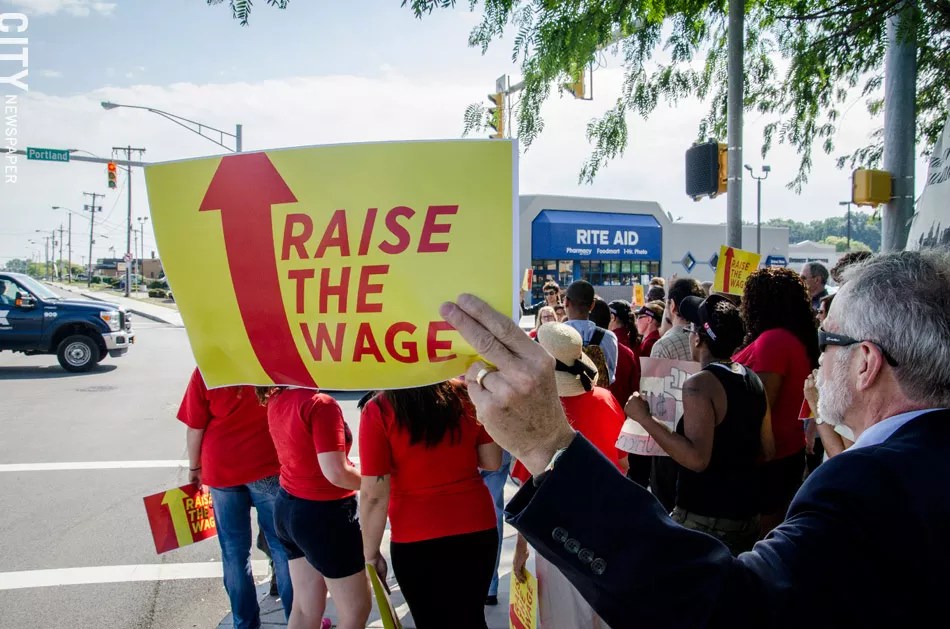
Nonetheless, through existing unions, union-affiliated
organizations, and populist coalitions that focus on worker issues, America’s
grassroots have come alive with organizing campaigns to reverse the rampant
inequities and abuses being perpetuated every day by the plutocratic powers: fast-food
workers and the “Fight for $15,” adjunct college professors, Moral
Monday, a Grand Alliance to Save Our Public Postal Service, National People’s
Action, Black Lives Matter, Working Families Party, Amazon workers, Occupy Wall
Street, Our Walmart, United Workers Congress, and opposition to the
Trans-Pacific Partnership.
Such uprisings now exist in practically every zip code – from
Silicon Valley to most college campuses, from day laborers gathered at local
Home Depots to nannies in the homes of the rich. New groups are popping up
regularly, as unorganized, maltreated people not only get fed up, but also see
other groups standing up, getting organized, and showing the way. From Pope
Francis to Bernie Sanders, the call for new egalitarian policies to advance the
ethic of the common good is resonating with people who only a few years ago
passively accepted corporate dominance.
The H-1B and H-2 people
Anyone still believing that workplace
atrocities are things of the past needs to meet some of the immigrants in our
country.And not just undocumented workers.
Much more attention should be given to the outright abuse of people who not
only have the proper paperwork, but who are actually corporate sponsored.
Two distinct groups of foreign workers are being brought here
under special US visas to be “Guest Workers.” Both sets of guests are
imported for one reason: to inflate the bottom lines of powerful, very
profitable corporations by giving them a cheap, easily exploitable workforce.
This artificially distorts the labor supply, suppresses wages, and
redistributes income from the many to a rich few.
H-2: Low-tech labor. The government’s H-2 visa category is a
boon to corporations dependent on manual labor but unwilling to pay high enough
wages to attract American workers. The handy H-2 “rent-a-worker”
program lets these companies import more than 100,000 low-wage workers a year
from impoverished communities in Latin America, Asia, and elsewhere. The
workers clean rooms in luxury resorts, peel crawfish in seafood plants, do the
sweaty things for landscape outfits, and otherwise toil at our economy’s bottom
rung, usually paid minimally (or less) by companies that profit from their
labor.
Our “guests” tend to be treated as the indentured
servants of their corporate sponsors. In a stunning new report this July titled
“The New American Slavery,” Buzzfeed.com found that H-2 workers are
commonly cheated on pay, made to work extremely long hours with no overtime
wages, forced to pay illegal fees, housed in squalid and dehumanizing
conditions (such as horse trailers), sexually harassed, not allowed to travel,
and kept under constant surveillance by employers and local police.
The “guests” can work only for the employer that
sponsored their visa. Plus, employers often confiscate (illegally) the workers’
passports.
Why doesn’t the government do something to stop these
outrages? Because Congress protects corporations, not people. Even though the
Labor Department, which administers H-2 visas, found violations of the guest
worker law in 82 percent of the cases it investigated last year, Congress funds
so few investigators and enforcement agents that the vast majority of companies
bringing foreign workers to our Land of the Free are not monitored. If a
company is prosecuted, fines are minor, and even repeat violators can keep
getting new workers through the program. Almost none of the abusers are ever
charged with a crime.
H-1B: High-tech labor. At the opposite end of the
guest-worker scheme are visas reserved for brand-name
corporate giants wanting to import college-educated workers with
specialized information-technology skills. But wait: Don’t we have a lot of
top-notch IT specialists born and raised on our own soil? And aren’t the high-tech
fields of science-technology-engineering-math (STEM) – a priority of the US
educational system – already producing twice as many university graduates as
there are jobs? Yes and yes. But the royals of high tech -companies such as
Facebook, Google, Hewlett Packard, Intel, and Microsoft – don’t want to pay the
market rate of salaries, benefits and promotions that good IT employees can
command.
So to break the workers’ power, the industry’s PR
specialists first concocted a “crisis” by saying that America’s
educational system fails to produce the number and quality of STEM graduates
that their corporations must have, thus creating a brainpower shortage that
threatens tech innovation. Second, their lobbyists, using ample campaign
donations as a lubricant, keep convincing Congress that the only solution to
this national emergency is to let the corporations import more tech workers
from abroad.
This phenomenally rich industry is presently allowed to
bring 65,000 foreign workers to their campuses each year. In violation of
federal laws, the corporations do not “make every effort” to find
qualified US employees before seeking H1-B workers, nor do they pay the
prevailing US salary to these workers. The temporary visa holders generally don’t
get promotions or retirement benefits, and after being used for three years or
so, they’re sent back home to be replaced by a new batch of disposable
foreigners.
High-tech execs insist they wouldn’t think of misusing the
program to fluff up their own profits, but just this year it’s been revealed
that both Disney Inc. and Southern California Edison have fired hundreds of
their US technology employees after getting the okay to import temporary
foreign workers. Then the corporations required the displaced Americans to
train their replacements as a price of getting any severance pay.
Meanwhile, industry lobbyists are demanding that Congress triple
the number of high-tech workers they can import each year.
Onward
Chiseled into the marble facade of the US Supreme Court
building is this noble sentiment: “Equal justice under law.” But most
Americans today know that there’s no use hoping that the next president, the
Congress, or the courts will turn the country’s egalitarian pretensions into
fact. Only you and I can do that by building, step by step, a grassroots social
justice movement.
The good news is that various progressive campaigns and
coalitions are out there, building and beginning to unite into a whole much
bigger than its separate parts. In the spirit of that first Labor Day, let’s
take heart in this rising rebelliousness, join the parade, and take part in
lifting our society closer to America’s highest democratic ideals.
Texas populist Jim Hightower is the writer and editor of The
Hightower Lowdown.
This article appears in Sep 2-8, 2015.





