When James Howard Kunstler’s first book, “The Geography of Nowhere,” came out
in 1994, talk about running out of oil was akin to talk about that fake moon
landing. Crackpots, oil executives, and every undergraduate geology student in
the county knew we were approaching the peak of worldwide oil production, but
most people had better things to worry about. Most still do.

Almost immediately after his book was published, Kunstler
become the go-to guy for biting criticism of America’s
built environment. His four non-fiction books and popular blog (The Clusterfuck Nation Chronicle)
have focused on the unsustainable aspects of our culture. Like a revival
preacher, he has railed against what he sees as our asinine insistence on
constructing car-dependent sprawl and our blindness toward our impending energy
problems. His message is to repent while there is still time.
Extreme,
maybe. Wrong, maybe not. Increasingly, the concept of an end of the cheap oil
era has been percolating into the mainstream culture on the wings of Iraqi war
critics. Major media outlets including Time,
National Geographic, and “60 Minutes” have weighed in, but none
have taken Kunstler’s view that the results will be an end to globalism,
suburbs, and easy motoring. Kunstler sees a wholesale change in every aspect of
our lives.
Kunstler has become the kind of lecturer that groups bring
in when they want to stir up debate about planning for our collective future. Locally,
the RochesterRegionalCommunityDesignCenter and
the Rochester chapter of the
American Institute of Architects will host a lecture by Kunstler at the German
House on April 11.
Kunstler went to college at SUNY Brockport in the late 60’s,
and while not a civic planner by trade, he has a familiarity with Rochester
that many of the out-of-town consultants the city has brought in do not. To
find out why he, and many others, feel we could be facing what he calls “a long
dark age,” I sat down with him in his Saratoga Springs
home to get his take on the future of Rochester
post cheap oil. The following is an edited version of that interview.
City: What do you say to people who believe someone will find a
technological solution to our energy problems?
Kunstler: I say
that is a faith-based idea. We haven’t always come up with something in the
past. If anything, history tends to show that major complex civilizations tend
to collapse, and they tend to collapse in the same way. As far as industrial
civilization goes, this is only a 200-year experiment. We’ve had two or three
turnovers in fuel. We’ve gone from wood to coal to oil to natural gas and to
some degree to uranium.
There is a prevailing idea now that some mythical “they”
will come up with a rescue remedy to the problem we have, which is, namely, an
over-reliance on a particular finite resource. When societies meet big stress
points, the delusional thinking tends to increase. All the wishing in the world
is not going to alter the fact that no combination of the alternative fuels
that are known about right now will enable us to run the interstate highway
system, Wal-Mart, Walt Disney World, and all the other furnishings of our
society the way we have been running them. We are going to have to scale down a
lot.
It’s the psychology of previous investment, which means
you’ve put so much of your culture’s resources and wealth into a certain way of
life that you can’t imagine letting go of it, or reforming it. This is the
unfortunate and tragic situation that we are in with suburbia. It is a very
deep set of investments we have made.
What about finding a replacement fuel?
We can say this: the amount of disinformation that is coming
out of the major media is shocking and disgraceful. “60 Minutes” has run two
segments this winter that are just basically false. The first one was about the
Alberta tar sands, in which they
said in essence that the Alberta
tar sands would solve all our problems. The second one said that coal
liquefaction would solve all our problems. Both of those things are completely
untrue.
Here comes CBS at 7 o’clock
on Sunday night telling the American people that their troubles are over. This
does such an amazing disservice to our country. This supports exactly the kind
of delusional thinking that we don’t need. Now the American public is going to
be sitting around saying, “I don’t need to change my behavior. I just have to
kick back and wait until someone solves this problem for me.”
Upstate New York has
been looking into wind power. Do you see these technologies playing a role in
our future?
I see them playing a role, but not the role that people
expect. I don’t think we will do it on the mass Niagara-Mohawk basis. I think
that mostly what we will see is these things being used on a household basis,
or the extremely local basis, if at all.
One thing that many of the people in this discussion have
not reckoned with is that we are going to have trouble manufacturing components
for these things as the bottom falls out of our cheap fossil-fuel economy. It is
one thing to say, “Oh yeah, we can do wind power. No problemo.” It is another
thing to factor in that you need exotic ores, you need very high-tech
metallurgy and high-energy fabrication techniques to make these things.
With windmills in particular, you have to change out the
turbines and parts now and again, so you’re talking about exotic replacement
parts. I am not sure if we are going to be able to make these things if we just
have a wind-power or solar-power economy. We can kick back now while we are
still basically immersed in the oil and gas economy, but 30 years from now it
may be a lot more difficult.
When I said that no combination of alternative fuels will
allow us to run our shit the way we have — there will be provisional
technologies. We are not going to run the interstate highway system on bio
diesel or second-hand French-fry potato oil or switch-grass byproduct. That is
all wishful thinking.
I think we are going to run into big trouble with natural
gas for home heating within the next two years. We should have had trouble this
year, but we had a supernaturally warm winter in the northeast. That is going
to change the way people regard the 3000 or 4000-square-foot house and their
ability to live in it.
The major change we are going to see is this: a reversal of
the 200-year-old trend of people moving from the rural areas to the big cities.
For one thing, we are going to get in big trouble with agriculture. I mean the
Archer Daniels Midland Cheese Doodle and Pepsi Cola model of agriculture. We’re
going to have to grow food closer to home. Agriculture is going to come closer
to the center of American life and the American economy.
Do you think the urban core is going to be restored?
You can already see this in places like Baltimore.
The waterfront is going to become a locus of activity again, and not just a
place for trails, and parks, and recreation, and condos. It will become
important again in a way that it hasn’t been important in 60 or 70 years.
I think the big cities are going to contract rather severely
at the same time as they densify. At the same time, we are going to have to
deal with the failure of the suburbs around the cities. The small towns and the
smaller cities will become viable in a way that they haven’t been for 70 years.
Small cities we have in New York
could see their futures reversed.
What happens to the places that are over-burdened with large
buildings? Places like Manhattan
and Chicago are going to be in a
lot of trouble, because I don’t think we can run those buildings without cheap
fossil fuels and in particular, natural gas. The 60-story condo building is not
a typology that came along until we had cheap natural gas for heating. I don’t
really see that we are going to put coal furnaces in the bottom of the Sears Tower
in Chicago and have shifts of 20 guys apiece to keep the building warm.
Most of our cities are where they are because they occupy
important sites. They may contract and they may wither, but most of them are
not going to disappear. Some of them will. I think that Phoenix
and Las Vegas, these highly
artificial places that have only been able to survive because of cheap fossil
fuels, they will dry up and blow away. Places like Rochester
and Buffalo and Boston:
these places are not going to disappear, but they are not going to be the same
kind of cities that we had in the 20th century.
New YorkState and
the communities along the canal have put forth a great effort to revitalize the
canal as a recreational resource. Do you think that the canal system will be
restored as a shipping channel?
It’s hard to say. That kind of water transport is fairly
cheap, and we may need it again. We are very fortunate that we didn’t allow
that system to deteriorate.
I did an internet search the other day and came up with 398 houses for
sale in the city of Rochester for
under $50,000. Do you think it would be a smart idea to buy one?
That’s hard to say. They might represent a good investment
in the long run. A lot of the neighborhoods in central cities may come back in
ways that we can now not imagine.
Do you think that the decline of the manufacturing base in places like Rochester has
an environmental upside?
I think we can get a little neurotic about it. We are
certainly neurotic about the brownfields. We have a lot of industrial
brownfields where industrial processes occurred, but it doesn’t mean that we
can’t build on them or live on them successfully. Obviously you would have to
take it on a case-by-case basis, but right now I think we are
hyper-super-ultra-excessively sensitive about it. It is one thing to garden on
a place; it is another thing to build masonry buildings on sites that are
basically capped.
Part of the reason that you can’t easily predict exactly
what is going to happen has to do with the nature of how human societies
change. You can describe it as emergent self-organizing behavior, just as the
suburbs represented a kind of emergent self-organizing behavior in response to
super-abundant cheap fossil fuels. There wasn’t a malign intelligence behind it.
The devil didn’t make Greece
and Henrietta. The pattern replicates itself all over America.
It is not like the suburbs of Rochester
are that special.
It is clear that
humans are pretty good at organizing themselves into whatever seems to work
best right now. People are resourceful, and it’s true that there is such
a thing as true human ingenuity. People do these things in the face of
necessity and desperation. You’ll have a situation where you have a society
that no longer has cheap energy, but things still need to get done. People
still need to be fed. People still need to be clothed. People still need to
move from point A to point B.
One of the biggest complaints about Rochester is
the weather.
I’m not sure I would make plans for the city of Rochester
based on what the weather will be in 10 years. There are plenty of places in
the world where the weather ain’t that wonderful. Oslo,
Copenhagen, Stockholm,
Edinburgh, Dublin.
These are places that don’t have nice weather, but they have among other things
a beautiful public realm that people care about. There are plenty of ways to
live in cold weather and be rewarded on a daily basis, to have beautiful places
to pass through on your way from home to work.
The weather in Paris
isn’t even that wonderful, though it’s a little bit better than Oslo.
Yet it is not as if the people in Paris
are miserable. Why? Because they have a beautiful city that was consciously
created to be beautiful.
In Rochester you
are completely unrewarded, because the streetscape sucks. The public realm has
been given no thought whatsoever and no care. We’re so much in the habit of not
caring and not thinking about it that the result is that we have exactly what
we deserve. We have a human habitat that is not worth living in.
That is another thing that is not so special about Rochester.
The public realm in Albany sucks,
too. It also sucks in Worcester,
Mass, and in Wilmington, Delaware,
and in Charlotte, North Carolina,
and in Austin, Texas,
and in Albuquerque.
I’d like to think Rochester has
a few advantages that other cities don’t. Rochester has
a pre-car infrastructure.
That is quite true, but you can say that about a lot of
Eastern cities. They have what I would call a basic civic armature that you
could build on, but you have to follow the pattern. You have to return to the
pattern, and we have not been accustomed to that for a long, long time.
It starts with something as fundamental as the increment of
development. Now, if you’re going to do a redevelopment in downtown Rochester,
you’ll do a whole block. That’s bullshit. We have to return to the idea of the
normal building lot as the normal increment of redevelopment. And we are going
to, because we are going to be a less affluent society. You have to go back and
actually look at the older pattern and see how the pattern was originally
imagined and then really start to emulate it.
My youngest daughter will turn 16 in 2018. Do you think I will need to
teach her how to drive?
I think the car is going to be a very diminished presence in
our lives in a way that most ordinary people cannot imagine. I think driving is
going to be an enormous problem for us and it will take on tragic overtones for
the younger generation.
There is this idea
from Fredrick Jackson Turner that it is the frontier experience that makes America exceptional. Do you see converging
catastrophes being a new frontier? Do you think that this sort of challenge
will bring out the best in Americans?
The guys who wrote a very interesting book called the “Forth
Turning,” William Strauss and Neil Howe, made the point that we are entering a
time when the younger generation is going to be so severely challenged that
they will have no choice but to be heroic. Now that is a very interesting idea,
because were not seeing a whole lot of evidence of that right now.
I think we are going to be forced, and I think we are going
to hit a wall. We are doing absolutely nothing right now to change our behavior
in the face of circumstances that are obviously mounting before our eyes. When
that happens, there are simply going to be a lot of 20-year-old kids that find
that their colleges are closing down. The public diploma mills are not going to
be able to keep on going. What are they going to do in 2011? They are going to
have to be very resourceful.
I don’t think we are going to be able to run those fleets of
yellow school buses. The investment in all that infrastructure is so enormous
we will probably see an enormous effort to keep it going against all odds, and
the effort will fail. In the meantime, what I think we will see is a
private-school movement growing out of something like home schooling. At the
same time I wouldn’t make any plans for the state university systems.
What are we going to wish that we had done?
We are going to wish that we had rebuilt the American
railroad system. We are going to wish that we had not built so many of our
institutions on the edge of town. Were going to be sorry we paved over some of
the best agricultural land close to our towns. We are going to be sorry that we
burned as much of our own oil and gas as we did. These are the kind of things
we are going to regret.
Is there a tipping point?
There is a point with gasoline and oil beyond which things
are not going to work in America.
That may be $4 a gallon, let’s say hypothetically. We haven’t quite reached it,
but it’s out there.
Will history judge us as fools?
I think history will judge us very harshly if history is
still there to do any judging.
James Howard Kunstler will speak at the German House, 315
Gregory Street, at 7
p.m. Wednesday, April 11. His topic: “How Will Our Cities Respond
to the Coming Energy Crisis?” The program is sponsored by the RochesterRegionalCommunityDesignCenter
and the Rochester chapter, American
Institute of Architects, as part of their series, “Reshaping Rochester!
Planning for the Public Realm.” Tickets: $10 in advance, $15 at the door; $5
students, available at Wegmans, Parkleigh, AIA Rochester (232-7650), and RRCDC
(271-0520).
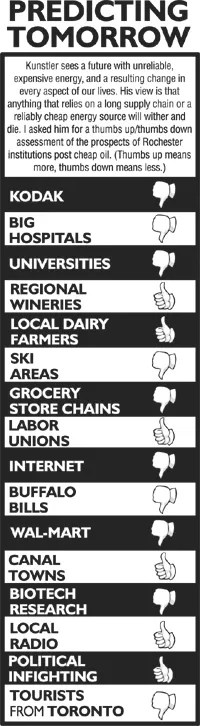
Predicting tomorrow
Kunstler sees a future with unreliable, expensive energy,
and a resulting change in every aspect of our lives. His view is that anything
that relies on a long supply chain or a reliably cheap energy source will
wither and die. I asked him for a thumbs up/thumbs down assessment of the
prospects of Rochester institutions
post cheap oil. (Thumbs up means more, thumbs down means less.)
This article appears in Apr 5-11, 2006.