


While unemployment is down both locally and nationally, the Dow is up, and the economy is clearly improving, Rochester is bucking the trends and sinking deeper into poverty. And the city’s children are suffering the most.
Rochester now has the distinction of being the only one of similar-sized cities to have more than 50 percent of its children living in poverty, according to an updated report from ACT Rochester and the Rochester Area Community Foundation.
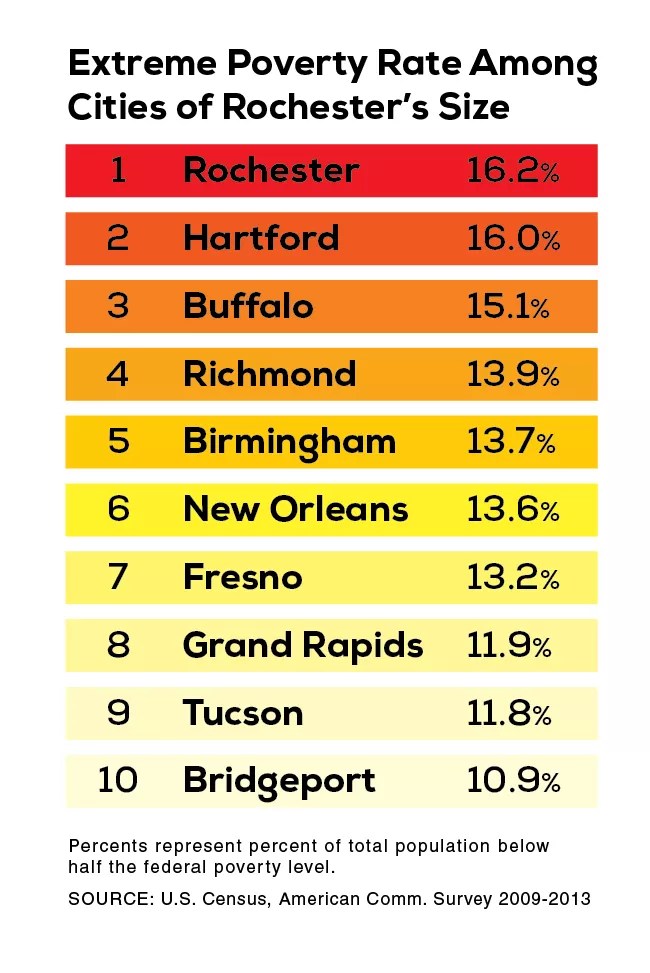
Among those cities, Rochester also has the highest rate of extreme poverty – 16.2 percent – which is defined as people living below 50 percent of the federal poverty level, according to the report. That’s a family of four living on less than $12,000 annually.
Decades after President Lyndon Johnson declared war on poverty, Detroit; Cleveland and Dayton, Ohio; and Hartford, Connecticut are the only US cities with higher rates of childhood poverty than Rochester. It’s a strange, almost surreal evolution for a city that has more than once been cited as one of the country’s great boom towns. And it begs the question: Why?
“The biggest issue is the complexity of poverty and how hard it is to get out of poverty once you’re in it,” says Ann Johnson, program director for ACT Rochester. And, she says, there are different types of poverty – situational and generational — both with their own sets of challenges.
For low earners, a single event such as a health crisis or job loss can send them into poverty. Generational poverty is different, Johnson says.
“The lift to get out may even be heavier,” she says, because there are multiple factors. Among the biggest is the cost of housing, she says. Rochester has more than 50 percent of Monroe County’s rental properties — the main housing option for poor people. While federal guidelines for housing expense says it should not exceed 30 percent of an individual’s income, in Rochester whites spend 35 percent, Hispanics spend 48 percent, Asians spend 35 percent, and blacks spend 50 percent.
“If you’re making a low wage and half of your check goes to housing, what’s left for utilities, food, child care, and transportation?” Johnson says.
Education is another factor, she says.
“So few of our Rochester City School District children are reading at third-grade level by the time they’re in third grade,” Johnson says. “And the inability to read well at that point puts stress on your entire foundation of education because you’re reading to learn at that point.”
Johnson says that some issues are also difficult to quickly resolve, such as access to transportation and health care, and having an obstacle to employment like a criminal record.
“There’s no silver bullet,” Johnson says.
This article appears in Jan 7-13, 2015.







It’s folly to spend more to fight poverty. Let’s put people to work at 40 hrs/wk minimum. In addition, we need a government that encourages people to save more and to be responsible. Leadership by example is ALWAYS in good taste.
Rochester has a poverty problem which cannot be denied. That said, the data from the Rochester Area Community Foundation needs to be examined closely. The poverty rate data works against old northeast and northern midwest cities which suffer from arbitrary boundaries – boundaries which make the cities a tiny percentage of the metro area as a whole. For instance. the city of Rochester comprises only 19.4% of the entire metro area. Conversely, Raleigh, NC comprises 35.5% of its metro area and Oklahoma City comprises 46.3% of its metro area.
If the city of Rochester were redrawn to include Irondequoit, Brighton, Greece, and Henrietta, the city would then make up 40% of the metro area and an apples to apples comparison could be made. Under such a circumstance, the poverty rate would fall from 32.9% to 19.9% – BELOW the midpoint of 22.9% for similarly sized regions. That would place Rochester in the ballpark of Raleigh (16.2%), Oklahoma City (18.2%), and Salt Lake City (19.9%).
Again, this is not to deny our poverty problem. It simply serves to:
1. Promote a more fair discussion
2. Avoid making our self-perception problem worse than it needs to be
The article states that the high cost of housing contributes to poverty. What irks me is how many of our elected officials are millionaires and how many own rental property.
If you look at the numbers and the continued growth in poverty levels, one conclusion you can come to is that organizations like ACT Rochester and the Rochester Area Community Foundation have made no impact whatsoever on reducing the problem. Neither organization – or any other group supposedly “battling poverty” – is willing to tackle the true drivers of poverty: an explosion in out-of-wedlock births and rampant truancy for school age kids in the city of Rochester.